Framer
Framer is a no-code website builder for teams that want visual design control, responsive layouts, CMS content, SEO tools, analytics, and managed hosting. Its AI agent can create editable pages, sections, copy, and visuals within a project. Teams can collaborate in real time and use branching, staging, and previews. Framer supports custom components, integrations, and code-based extensions; its integration guides cover tools including Meta Pixel, Typeform, webhooks, Loom, and Google Analytics. Third-party plugins extend it with content generation, asset management, integrations, and automation. The Canvas requires an internet connection and a supported browser on Windows, macOS, Linux, or ChromeOS; desktop apps are available for macOS and Windows. Published sites support macOS, Windows, Linux, Android, and iOS through supported browsers. The Free plan includes a Framer domain, 10 CMS collections, and 1,000 pages, but not a custom domain. Basic costs $10 per month and includes a custom domain; Pro costs $30 per month and adds staging and branching with previews. Framer does not offer code export.
Who it is for
Framer suits teams building and managing websites who want visual design tools, CMS content, and managed hosting. Its collaboration features may help teams working together on site changes.
What is good
- AI agent creates editable pages, copy, and visuals.
- Supports real-time collaboration, branching, staging, and previews.
- Hosting is included.
- Free plan includes 10 CMS collections and 1,000 pages.
- Published sites support Android and iOS browsers.
What to know first
- Free plan does not include a custom domain.
- Framer does not offer code export.
- Canvas requires an internet connection.
- Workspaces without a subscription support up to three editors.
The Geeks Club review
Framer: the full review
Framer combines visual site building, CMS, team collaboration, and managed hosting. The free plan has no custom domain, and users who need code export will need another approach.
Overview
Framer is a visual, no-code website builder for people and teams who want control over design while managing site content and publishing in one place. It is strongest for design-led sites and collaborative workflows; it is a weaker fit for commerce or projects that must be exported as code.
Key features
Design, content and publishing
Framer combines visual design tools and responsive layouts with a CMS, SEO tools, analytics and managed hosting. Its AI agent creates editable pages, sections, copy and visuals within a project, giving teams material they can continue shaping. Blogging is supported, and search engines can crawl and index published sites unless a page is set to noindex.
Custom components, integrations and code-based extensions add room to adapt a site. Framer components can also be reused in React environments outside the platform. But code export is not supported, so teams that need to move a complete site elsewhere should choose a different approach. Framer has selling tools and video hosting, but no e-commerce; it is not the right choice for a business that needs a built-in online store.
Team workflows and technical requirements
Real-time collaboration, branching, staging and previews give teams ways to coordinate changes and review work before publishing. Workspaces without a subscription are limited to three editors, which may constrain a larger team even when it is only exploring the platform. Integrations include Meta Pixel, Typeform, webhooks, Clay, Loom, Trustpilot, Google Analytics and Google Tag Manager; third-party plugins extend the platform with content generation, asset management, integrations and automation.
The Canvas requires an internet connection and a recent Chrome, Safari, Firefox or Edge browser on Windows, macOS, Linux or ChromeOS. Desktop apps are available for macOS and Windows. Published sites support macOS, Windows, Linux, Android and iOS, subject to supported browser versions. Framer states that it has ISO 27001 compliance, completed a SOC 2 Type 2 audit, and is committed to GDPR and CCPA compliance. It also describes controls including TLS 1.2 or higher, HSTS, regular penetration tests, code review and security scanning.
Pricing
Framer has a free plan and paid plans. The free tier includes 500 AI credits to try, a free Framer domain, 1 GB of bandwidth, design pages, 10 CMS collections, 1,000 pages, 5 MB file uploads and one free locale. It is useful for a small project or a trial of the workflow, but it does not support a custom domain, and collaboration is capped at three editors in workspaces without a subscription.
Basic costs $10.00 per month, billed per month. It adds a free custom domain, 50 GB of bandwidth, built-in SEO and a localization add-on, but includes only two CMS collections. That makes it a sensible step up for a modest site that needs its own domain, while the reduced collection count versus Free matters to anyone relying on a larger CMS structure.
Pro costs $30.00 per month, billed per month. It raises the CMS allowance to 10 collections and bandwidth to 100 GB, and adds site redirects, a staging environment and branching with previews. Teams managing more substantial content or controlled releases have a clearer reason to pay for Pro; smaller sites may not need those additions. Enterprise has custom pricing and custom limits.
The pricing model also identifies an annual-billing starting point of $10/mo. A free trial is available. Choose a plan based on its stated billing term and the limits that matter to the site, particularly bandwidth, CMS collections, domain needs and team size.
Platforms
Framer is listed for Android, iOS, Linux, macOS, web and Windows. The Canvas browser and connection requirements still apply to site-building work, while published sites support desktop and mobile operating systems through supported browsers.
Who it's for
Framer suits individuals and teams building design-led sites, blogs or portfolios who value visual control, a built-in CMS and managed hosting. Teams that need shared editing, previews and staged changes can benefit from its collaboration tools, provided their editor count and plan limits fit. Look elsewhere if the project depends on offline Canvas work, full code export or built-in e-commerce.
Pros and cons
- Pros: Visual design, CMS, SEO and managed hosting sit in one workflow, reducing the need to assemble separate site-building and publishing tools.
- Pros: Editable AI-generated pages and sections, plus real-time collaboration and preview workflows, support iteration by a team.
- Pros: The free plan has generous stated page and CMS collection counts for trying a site project, and paid plans add custom domains.
- Cons: The free plan has no custom domain and limits unsubscribed workspaces to three editors.
- Cons: There is no code export or e-commerce, limiting its fit for portable builds and online stores.
- Cons: Basic includes two CMS collections, fewer than Free's 10, so some sites may need Pro to retain a larger collection allowance while adding paid-plan features.
Alternatives
Choose Drupal instead if you want free, open-source software and are prepared for self-hosting and technical setup. For ready-made designs, compare Website Template Marketplaces or Webflow Marketplace, which offers free templates for personal and commercial projects. Creative Tim Marketplace is another option for browsing and downloading free templates, with a paid monthly access pass also available.
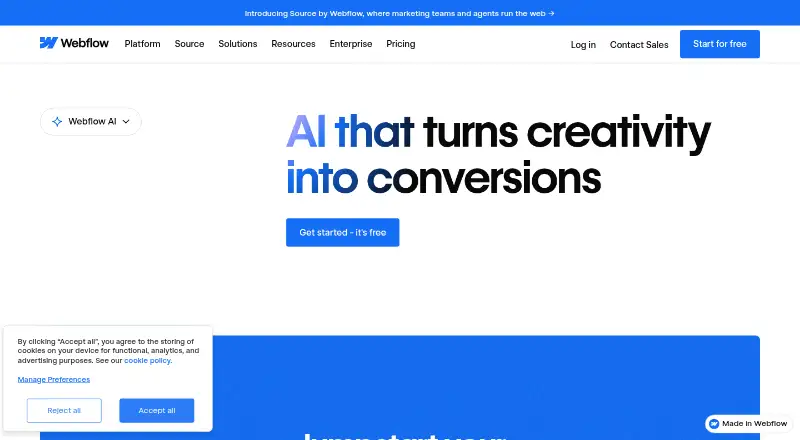
If you want an AI-oriented site builder, Webflow AI has a free Starter plan with a Webflow.io domain, limited CMS, two static pages, 1 GB bandwidth, 50 form submissions, Webflow AI and an MCP server. For a portfolio-focused search, browse Portfolio Website Builders; for a specific professional or personal site, see Dental Website Builders, Law Firm Website Builders, Music Website Builders or Personal Website Builders.
BootstrapMade offers a free license for personal projects, with restrictions including required footer credit and no client work. Consider BigCommerce, Shopify or Shopware as alternatives.
Verdict
Choose Framer for a design-led site where visual control, CMS content, hosting and team workflows belong together. Its strongest case is the combination of editable creation tools and collaborative publishing; look elsewhere if you need e-commerce, offline Canvas work or code export.
Framer plans and pricing
All plansCompared on AI website builders
- Free plan
- Yes
- Paid from
- $10/mo