The Geeks Club is reader-supported. When you buy through links on our site, we may earn an affiliate commission. As an Amazon Associate I earn from qualifying purchases. Learn more
The Zoom H1essential is the best internal-microphone recorder for most buyers in 2026 because it is light, inexpensive, records up to 96 kHz/32-bit float, and uses a simple fixed XY stereo pair. Choose the Zoom H2essential when selectable pickup patterns matter more than simplicity; the Tascam DR-05XP for omnidirectional ambience, lectures, and long sessions; and a multitrack model such as the Tascam FR-AV4, Zoom H6 Essential, or Sound Devices MixPre-6 II when you will connect external microphones. The right choice depends less on the headline bit depth than on microphone pattern, input count, power, storage, and how much control you need in the field.
Which internal audio recorder is best in 2026?
Handheld recorders with built-in microphones remain the quickest way to capture rehearsals, interviews, lectures, room tone, wildlife, and location sound without carrying a mixer. Every model below records to removable flash media and can work untethered, but their microphone geometry and external-input options are very different.
| Recorder | Built-in microphones and pattern | Maximum format | External inputs | Power and storage | USB or weight notes |
|---|---|---|---|---|---|
| Zoom H1essential | Fixed XY stereo pair | 96 kHz/32-bit float | Not stated | Two AAA batteries; SDXC up to 1 TB | 92 g with batteries; USB-C; USB microphone mode |
| Zoom H2essential | Three internal microphones; 120°, 90° and mono patterns | 32-bit float | Not stated | Storage and battery figures not stated | USB microphone operation |
| Tascam DR-05XP | Fixed omnidirectional microphones | 96 kHz/32-bit float | Not stated | Two AA batteries; more than 17 hours; microSD up to 512 GB | 125 dB SPL microphone handling |
| Tascam DR-07XP | Swivelling unidirectional microphones; AB/XY orientation | Up to 96 kHz/32-bit float | Not stated | Battery and card figures not stated | Adjustable microphone geometry |
| Tascam DR-40XP | Built-in microphone details not stated | Not stated | Two XLR/TRS inputs | Not stated | Designed for external balanced sources |
| Tascam FR-AV4 | Built-in microphone details not stated | Not stated | Four combo inputs; six channels | Not stated | Multitrack field recorder |
| Zoom H6 Essential | Built-in capsule | Not stated | Four combo inputs | Not stated | Four external inputs plus capsule |
| Sound Devices MixPre-6 II | No built-in microphones | Not stated | Professional multitrack input section | Not stated | For users bringing external microphones |
These are standalone hardware products rather than subscription applications. They have no free software plan or trial; purchase prices and stock vary by retailer and region. The figures above come from Zoom, Tascam, Sound Devices and MusicRadar’s 2026 specifications.
The Tool Desk
Outbyte Driver Updater FREEScan for outdated or missing drivers - takes under a minuteDriver Scan →Outbyte PC Repair FREERepair Windows errors before they cause bigger problemsFix Now →How should you choose an internal recorder?
Choose the microphone pattern before the bit depth
A fixed XY pair gives predictable stereo width and a compact design, which is why the H1essential suits general music and spoken-word capture. Omnidirectional capsules hear more evenly around the recorder and can be useful for a lecture or room ambience. Adjustable AB/XY capsules let you alter stereo coverage, while the H2essential’s 120°, 90° and mono modes let one recorder handle narrow speech, conventional stereo, or a wider scene.
Shopping ad

- CREATE CONTENT WITH BETTER SOUND – Capture clear stereo audio for videos, reels, tutorials, voiceovers, behind-the-scenes clips, and other content that needs more polished sound than your camera or phone alone.
- READY WHEN INSPIRATION HITS – Record songwriting sessions, rehearsals, acoustic performances, lessons, jam sessions, and live music with detailed sound that is easy to capture in the moment.
- CLEAR VOICES FOR PODCASTS AND INTERVIEWS – Record conversations, podcast episodes, lectures, meetings, notes, and interviews with natural stereo sound that helps voices come through clearly.
- CAPTURE REAL-WORLD SOUND – Record ambience, nature, room tone, sound effects, travel audio, and everyday environments for video, music production, creative projects, and documentation.
- PLUG IN FOR STREAMING AND CALLS – Connect via USB-C and use it as a microphone for livestreams, remote meetings, video calls, voiceovers, podcasts, and desktop or mobile recording.
When do balanced inputs matter?
XLR/TRS inputs are the upgrade path for external microphones, mixers and multiple guests. The DR-40XP has two; the FR-AV4 has four combo inputs and six channels; the H6 Essential has four combo inputs alongside its built-in capsule. If you expect to add microphones later, these connectors are more consequential than a higher sample-rate number.
What does 32-bit float actually change?
32-bit float reduces the need to set recording gain precisely before a take. It is a workflow convenience, not a guarantee of clean sound: MusicRadar notes that self-noise, preamp design and microphone placement still determine the noise floor and clarity. A badly placed recorder or a noisy source remains badly recorded.
How much power and storage do you need?
Battery and card limits determine whether a recorder is practical away from an outlet. The H1essential uses two AAA cells and accepts SDXC cards up to 1 TB. The DR-05XP uses two AA cells, supports microSD cards up to 512 GB, and is rated for more than 17 hours. Buy a card within the manufacturer’s stated limit and carry charged spares.
Recommended Free Tools
What accessories are essential outdoors?
A furry windshield is the most important outdoor accessory because wind can overwhelm otherwise good microphones. Also pack rechargeable AA or AAA batteries, a spare compatible card, headphones for monitoring, and a small stand or grip that keeps the recorder away from handling noise and nearby mechanical sources.
1. Zoom H1essential: best budget and lightest mainstream choice
The H1essential is the straightforward pick for creators who want a pocketable stereo recorder with built-in microphones. MusicRadar lists a 92 g weight with batteries, 96 kHz/32-bit-float recording, USB-C, and SDXC support up to 1 TB.
Shopping ad

- THE WORLD’S EASIEST RECORDER: With the push of a button the H1essential captures perfect audio for musicians, podcasters, filmmakers, and content creators. Simply hit record and discover the power of 32-bit float.
- 32-BIT FLOAT MAGIC : With 32-bit float recording, you never have to adjust levels. The H1essential captures every nuance of your sound ensuring high quality in every take.
- ACCESSIBILITY: The Essential Series was designed with Accessibility for the visually impaired. Navigate the menu with audible descriptions through the built-in speaker or headphones. Creators can choose English, Spanish, French, Japanese, German, Italian or Chinese.
- LOUD AND CLEAR: The onboard X/Y microphones capture clean audio up to 120 dB SPL, equivalent to the sound of a high-performance motorcycle.
- PRACTICE COMPANION FOR MUSICIANS: Musicians can use the H1essential to record every practice and rehearsal, a great way to improve your playing. Features like overdubbing and playback-speed-adjustment are great for writing and practicing.
- What it does: Captures a fixed XY stereo image for music, interviews, meetings, lessons and location ambience.
- Standout features: 32-bit float reduces gain-setting risk; USB-C allows computer connection and USB microphone operation; the two-AAA design keeps replacement cells easy to find.
- Platforms and workflow: It is a standalone recorder with removable SDXC storage and can operate as a USB microphone with a computer.
- Free plan, trial and price: There is no software plan or trial; it is a hardware purchase, with retailer pricing varying by region.
- Limits: The XY microphones are fixed, so you cannot switch to mono, a narrower angle or an omnidirectional pattern. The two-AAA power system also has less energy capacity than many AA-powered recorders.
2. Zoom H2essential: best for microphone-pattern flexibility
Zoom describes the H2essential as its only Handy Recorder with three internal microphones. Selectable 120°, 90° and mono pickup patterns make it the most adaptable built-in-microphone model in this group.
- What it does: Changes coverage for a single speaker, a conventional stereo source or a wide ambient scene without adding an external microphone.
- Standout features: Three internal microphones, 32-bit-float recording and USB microphone operation.
- Platforms and workflow: It functions as a standalone flash recorder and as a USB microphone when connected to a compatible computer.
- Free plan, trial and price: No free plan or trial applies; current hardware pricing depends on retailer and region.
- Limits: More patterns mean more decisions and setup checks than the fixed-pattern H1essential. Documented battery runtime, storage capacity and external-input details are not specified here, so it is less suitable when those limits are central to a field plan.
3. Tascam DR-05XP: best for omnidirectional ambience and long sessions
The DR-05XP uses fixed omnidirectional microphones and is rated for more than 17 hours from two AA batteries. Tascam specifies 125 dB SPL microphone handling, 32-bit float up to 96 kHz, and microSD cards up to 512 GB.
- What it does: Records lectures, meetings, rehearsals and environmental sound where an even pickup around the recorder is useful.
- Standout features: High 125 dB SPL handling, long stated battery life, 32-bit float and generous microSD capacity.
- Platforms and workflow: Standalone recording to microSD; the AA format is convenient for extended untethered work.
- Free plan, trial and price: It is hardware with no software plan or trial; retailer prices vary.
- Limits: The microphones are fixed and omnidirectional. You cannot rotate them into an XY configuration or narrow the pickup to reject sound from the sides.
4. Tascam DR-07XP: best when adjustable AB/XY microphones matter
The DR-07XP is the choice for users who want to change microphone orientation rather than accept a fixed stereo pattern. Tascam’s comparison information lists swivelling unidirectional microphones that can be arranged for AB or XY recording, with the same up-to-96 kHz/32-bit-float ceiling as the DR-05XP.
- What it does: Lets you choose a wider AB arrangement or a more coincident XY setup for different stereo perspectives.
- Standout features: Swivelling unidirectional capsules and 32-bit-float recording up to 96 kHz.
- Platforms and workflow: A standalone removable-card recorder; the adjustable capsules reward a deliberate setup before recording.
- Free plan, trial and price: No software plan or trial; hardware pricing varies by seller.
- Limits: Mechanical adjustment adds a positioning step and does not provide the H2essential’s 120°, 90° and mono pattern choices. Battery runtime and card capacity are not stated here.
5. Tascam DR-40XP: best two-input step-up recorder
The DR-40XP is aimed at users moving beyond a single built-in stereo capture. MusicRadar lists two XLR/TRS inputs, making it a practical bridge to balanced external microphones, a small mixer or two-person recording.
- What it does: Adds two balanced combo inputs for external sources while serving as a field recorder.
- Standout features: XLR/TRS connectivity gives you a clear upgrade path for microphones and line-level gear.
- Platforms and workflow: Standalone field recording with external balanced inputs; exact computer-platform details are not specified here.
- Free plan, trial and price: Hardware purchase only; no free plan or trial, and prices vary by retailer.
- Limits: It has fewer external inputs than the FR-AV4 or H6 Essential. Built-in microphone, battery, storage and maximum-format figures are not stated in the supplied specifications, so choose it primarily for its two-input expansion path.
6. Tascam FR-AV4: best for four external sources and six channels
The FR-AV4 is the multitrack option for a small production that needs more than two external feeds. MusicRadar lists four combo inputs and six channels, giving it substantially more expansion room than the DR-40XP.
Shopping ad
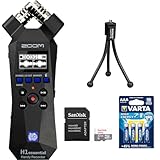
- Stereo 32-bit float recording - perfect audio with no need to set gain
- High-Quality X/Y Mics capture clean audio up to 120 dB SPL
- Records up to 96kHZ sample rate to SD card
- USB Microphone for PC, Mac, iOS, or Android using the USB-C Port
- Accessibility - Audio guidance function for the visually impaired
- What it does: Handles several balanced sources for interviews, small ensembles, documentary work or multi-microphone production.
- Standout features: Four combo inputs and six-channel operation.
- Platforms and workflow: A standalone multitrack field recorder intended for external-source workflows.
- Free plan, trial and price: No software plan or trial; hardware pricing is retailer- and region-dependent.
- Limits: It is more equipment than a casual lecture recorder needs, and the supplied specifications do not establish built-in microphone, battery, storage or sample-rate details. Plan for the size and cabling of a multitrack setup.
7. Zoom H6 Essential: best when you need four inputs plus a built-in capsule
The H6 Essential combines a built-in capsule with four combo inputs. That combination lets you start with the recorder’s own microphone and add several external sources as a project grows.
What’s actually slowing this PC down?
Pick the symptom - the matching free tool is one click away.
- What it does: Supports a built-in-capsule workflow and up to four external combo-input sources.
- Standout features: Four combo inputs provide more expansion than the H1essential or H2essential while retaining an internal microphone option.
- Platforms and workflow: Standalone multitrack hardware; the supplied specifications do not establish a particular computer operating-system list.
- Free plan, trial and price: No free plan or trial; purchase pricing varies by seller and region.
- Limits: It is larger and more complex than a simple stereo recorder, and the supplied figures do not state its battery life, card limit or maximum sample-rate/bit-depth combination. Buy it for input flexibility rather than for a documented lightweight specification.
8. Sound Devices MixPre-6 II: best professional multitrack option with external microphones
The MixPre-6 II is for a production that already has microphones and needs a professional multitrack recorder. MusicRadar’s specification table lists no built-in microphones, so it is fundamentally different from the other choices here.
- What it does: Serves as the recording hub for external microphones and other balanced sources.
- Standout features: Professional multitrack design and an input section intended for external-microphone workflows.
- Platforms and workflow: Standalone production hardware; bring and position your own microphones, stands and cables.
- Free plan, trial and price: No software plan or trial; hardware pricing varies by region and dealer.
- Limits: There is no built-in microphone, so it cannot replace a pocket recorder for spontaneous ambience or a lecture unless you also carry a microphone. The supplied specifications do not state its maximum format, battery runtime or storage limit.
What is the best recorder for lectures, music and field ambience?
Lectures and meetings
The DR-05XP’s omnidirectional microphones, high SPL handling and more-than-17-hour AA rating suit long, unattended sessions. The H1essential is easier to carry when you can place a fixed XY stereo pair near the speaker.
Music rehearsals and performances
Choose the H1essential for a simple stereo capture, the DR-07XP when AB/XY orientation is useful, or the H2essential when you want to change between 90°, 120° and mono pickup.
Nature and room ambience
The DR-05XP’s omnidirectional capsules favor an even environmental image. For directional control, use the DR-07XP’s swivelling unidirectional microphones or the H2essential’s selectable patterns, then add wind protection outdoors.
Shopping ad
- Stereo 32-bit float recording - perfect audio with no need to set gain
- High-Quality X/Y Mics capture clean audio up to 120 dB SPL
- Records up to 96kHZ sample rate to SD card
- USB Microphone for PC, Mac, iOS, or Android using the USB-C Port
- Accessibility - Audio guidance function for the visually impaired
Interviews, podcasts and documentary crews
Once you need separate microphones, move to balanced inputs: two on the DR-40XP, four on the FR-AV4, or four plus a built-in capsule on the H6 Essential. The MixPre-6 II is appropriate when a professional kit already includes external microphones.
How do you set up an internal recorder for a clean field take?
- Prepare media: Insert a compatible SD or microSD card that stays within the recorder’s documented capacity, then format it using the recorder’s own storage command before important work.
- Install power: Fit fresh or fully charged AA or AAA batteries and carry a second set. The H1essential uses AAA cells; the DR-05XP uses AA cells.
- Choose the microphone geometry: Set XY, AB, omnidirectional, 90°, 120° or mono according to the source and the coverage you need. On adjustable models, lock the capsules before the take.
- Enable 32-bit float when available: It reduces the need for precise gain setting, but it does not remove self-noise, preamp noise or placement problems.
- Control wind and handling: Fit a furry windshield outdoors, use a stand or grip, and keep the recorder away from fans, traffic, HVAC outlets and other noise sources.
- Monitor and preserve originals: Check with headphones, record a short lead-in, and copy the original files to two locations after the session.
Which accessories should you buy first?
- Wind protection: A furry windshield is essential for outdoor recording.
- Power: Rechargeable AA or AAA batteries matched to the recorder, plus a spare charged set.
- Media: A reputable SD or microSD card within the maker’s capacity limit; the H1essential accepts up to 1 TB SDXC and the DR-05XP up to 512 GB microSD.
- Monitoring and placement: Closed-back headphones, a compact stand and a shock-isolating grip reduce handling and environmental noise.
- Expansion: If you will add microphones, prioritize XLR/TRS inputs and the channel count before buying a more advanced internal microphone pattern.
Frequently Asked Questions
Can I leave a recorder running while I step away?
Only do so after checking battery status, available card space and the expected file size. A short trial recording and a visible time counter help confirm that the chosen pattern and placement are working before you leave the unit unattended.
Should I dedicate one memory card to field recordings?
A dedicated card simplifies file management and lowers the chance of deleting unrelated work during an in-device format. Copy the files to two separate locations before reusing the card.
Is an external microphone worth carrying with a handheld recorder?
It is worthwhile when you need to move the microphone closer to a speaker, reject side noise or use a lavalier or shotgun design. In that case, choose a recorder with balanced XLR/TRS inputs rather than relying only on its internal capsules.
What is the safest way to protect an outdoor take from wind?
Use a furry windshield over the recorder’s microphones and place the unit behind a natural barrier when possible. Avoid touching the body during the take, because handling vibration can travel directly into the capsules.
Quick Recap
Product prices and availability are accurate as of the date/time indicated and are subject to change. Any price and availability information displayed on Amazon at the time of purchase will apply.

